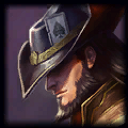
Team Synergy
Twisted Fate wants teammates who turn one locked target into a won fight. His best team functions are reliable front line, fast follow-up damage, extra crowd control after Gold Card, wave control so he can choose card safely, and someone who can punish enemies revealed or forced out of position. He is not the champion who wants five people slowly poking forever with no engage plan. If the team cannot protect him while he cycles cards, he gets forced to throw Blue or Red Card defensively and the whole pick loses bite.
-
Hard-engage tanks: Malphite, Amumu, Leona, Nautilus
Synergy mechanism: Twisted Fate gives these champions a clear starting target, and they give him the time to stand still, pick Gold Card, and throw Wild Cards after the enemy is held in place. A tank also absorbs the first answer from the enemy, which matters because TF is very punishable when he walks up with a visible card.
Combo: Let the tank show first and threaten the main engage. When an enemy steps sideways to dodge the tank, TF locks Gold Card and tags that player before they can reset spacing. The tank then commits crowd control on the stunned target or on the enemies trying to peel. If the tank lands first, TF should not greed for the backline; Gold Card the highest damage enemy who can counter-engage and make the engage clean.
Best scenario: This is strongest into teams with one or two key carries standing behind a thin frontline. The tank forces them to clump or burn mobility, then TF punishes the first bad step. It also works well when your side has Snowball pressure, because TF can hold Gold Card for the enemy who tries to punish the landing.
Enemy answer: Good enemies will spread, poke the tank before the engage, or hold displacement and cleanse-style tools for the Gold Card target. They may also bait TF into walking past his tank, then collapse on him instead of the engager.
Failure risk and recovery: The biggest failure is both players engaging different targets. If the tank dives deep while TF stuns the frontline, nobody dies. Recover by playing the next wave slower: TF clears, keeps Gold Card for peel, and waits until the tank has a clean angle again. Do not chase through the whole lane after a missed engage; TF is much better at catching the second approach than saving a doomed dive.
-
Reset and burst divers: Katarina, Samira, Pyke, Master Yi
Synergy mechanism: These teammates need one enemy to be unable to move or answer for a short window. TF supplies that first stop with Gold Card and can reveal or mark awkward targets so the diver does not waste entry on a tank. In return, the reset champion converts TF's single-target pick into a fight that keeps rolling.
Combo: TF should not throw Gold Card at the first champion visible every time. Wait for a carry, enchanter, or low-health enemy to step into follow-up range. Gold Card lands, Wild Cards go through the target path, and the diver enters only after the enemy's main peel is committed or the target is already locked. If the diver starts first, TF should hold Gold Card for the enemy who can interrupt the reset chain.
Best scenario: This pairing shines against squishy teams that rely on spacing instead of heavy frontline. It is also strong after your team chips enemies down, because TF's targeted stun removes the usual “just kite back” answer and gives the reset champion a clean first kill.
Enemy answer: The enemy will save exhaust-style debuffs, shields, knockbacks, and instant crowd control for the diver rather than the TF. They may also body-block the Gold Card target or force TF to stun a tank before the real carry is in danger.
Failure risk and recovery: The risk is impatience. If the diver jumps before TF has a card ready, the enemy burns them down and TF is left with no real threat behind his stun. Recover by changing the order: TF holds the wave, the diver hides pressure instead of showing, and the team waits for a target already chunked or separated. A failed reset comp should not keep chain-diving full-health enemies; use TF's poke and reveal threat to create a better first target.
-
Long-range poke and siege: Xerath, Varus, Jayce, Lux, Ziggs
Synergy mechanism: TF makes poke easier to land because Gold Card forces a target to sit in the skillshot line, while Red Card and Wild Cards help control minion waves so the poke champions can keep firing from safe space. Poke teammates also soften enemies enough that TF's next Gold Card becomes a kill threat instead of just a warning.
Combo: The clean pattern is simple: poke first, force movement, then TF punishes the predictable dodge path. If a target is hit by allied crowd control, TF adds Gold Card only when it extends the kill window or stops their escape; wasting it into a target already dead can leave the team exposed to the counter-engage. When enemies hide behind minions, TF can help thin the wave so Lux, Jayce, or Varus gets a better angle.
Best scenario: This is excellent when your team outranges the enemy and has enough disengage to stop hard commits. TF does not need to be the main damage source here. His job is to make the enemy scared to step up after taking poke, then punish the one player who gets greedy for a relic, cannon wave, or return trade.
Enemy answer: Engage teams will refuse the slow game. They will use Snowball, flanks, movement speed, or a frontline body to force through poke and reach TF or the artillery mage. Sustain-heavy teams can also erase chip damage if your side never commits on a stun.
Failure risk and recovery: The failure point is having five poke tools and no way to stop the first hard engage. If the enemy gets through once, TF cannot peel everyone alone. Recover by saving Gold Card for the diver, not for extra damage on the frontline, and by clearing waves early so the enemy has fewer minions and less cover for a forced engage. If your poke missed, back up immediately; do not stand in mid-lane waiting for TF to bail out three exposed teammates.
-
Protective enchanters and anti-dive supports: Lulu, Janna, Milio, Karma, Renata Glasc
Synergy mechanism: TF is much more dangerous when he is allowed to hold Gold Card without being instantly jumped. Enchanters buy him that extra beat with shields, disengage, movement help, or a second layer of peel. They also let him play closer to the fight, which makes his targeted card pressure harder for enemies to ignore.
Combo: TF stands just behind the front line, not next to the enchanter in the far back. When an assassin or bruiser commits, the support interrupts or slows the dive while TF locks Gold Card for the same target. If the enemy refuses to dive, the support helps TF step forward for a pick, then backs him out after the card lands and the enemy team starts throwing return damage.
Best scenario: This pairing is best into dive-heavy teams with one obvious entry champion. TF can ruin that champion's timing if he survives the first contact. The support's job is not only to save TF after he is low; it is to keep him healthy enough that he can threaten the next Gold Card without playing scared behind the turret.
Enemy answer: Smart opponents will split pressure. One champion baits Gold Card, another dives the enchanter, and a third holds damage for TF after the shield is gone. They may also poke the support first so there is no protection available when the real engage starts.
Failure risk and recovery: The risk is overprotecting TF while the actual carry dies, or TF walking too far forward because he trusts the support too much. Recover by assigning peel order before fights: if the diver can kill TF, Gold Card plus support tools go there; if the diver is only zoning, TF turns the card onto the enemy damage dealer instead. After a burned defensive cycle, reset behind the wave and wait. TF without Gold Card and support cooldowns is not a frontliner.
-
Pick and displacement partners: Blitzcrank, Thresh, Poppy, Anivia, Taliyah
Synergy mechanism: These champions turn TF's targeted crowd control into terrain traps, hooks, walls, and forced movement. TF can start the catch with Gold Card, or he can hold it for the enemy who survives the hook and tries to dash away. This style is less about full 5v5 engage and more about making the lane feel unsafe for one enemy at a time.
Combo: With hook champions, TF should hover near the hook line and be ready to Gold Card the grabbed target after they land, especially if the target has mobility or defensive tools. With wall and displacement champions, TF waits for the enemy to be boxed in, then stuns the highest-value target inside the trap. If Poppy is denying dashes, TF can safely card the grounded or pinned enemy rather than chasing deeper.
Best scenario: This is strongest against teams that need narrow lane spacing to function: short-range carries, immobile mages, and bruisers who must walk straight through the choke. Once one enemy is caught, TF's team can immediately create a numbers advantage without needing a perfect all-in.
Enemy answer: The enemy will stand behind minions, send the tank first, or hold mobility until after Gold Card is thrown. They may also hard engage the moment Blitzcrank or Thresh misses, because the pick team has fewer tools available during that punish window.
Failure risk and recovery: The risk is stacking every tool onto a tank and then having nothing left for the carries. Recover by taking the small win instead of forcing: chunk the tank, clear the wave, and make the next hook harder to ignore. If the pick misses, TF should immediately shift into peel mode with Gold Card ready. A missed hook plus TF walking forward is exactly the timing enemies want to punish.
Best team shape for Twisted Fate: one champion who can stand in front, one champion who can instantly damage a stunned target, one source of secondary crowd control or disengage, and enough wave clear that TF is not forced to choose cards while being shoved under pressure. If those jobs are covered, he becomes a constant catch threat. If they are not, he turns into a fragile card thrower who stuns one enemy and then has no team ready to finish the play.