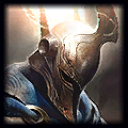
Passive - Bravado
Function: After Taric casts an ability, his next basic attacks become empowered and swing faster. Those hits are not just filler damage; they are how Taric keeps his spell cycle moving and turns a short trade into a real frontline pattern.
Mayhem use: In ARAM: Mayhem, fights start often and reset quickly, so Bravado is the difference between Taric being a walking shield button and Taric actually taking space. Cast, hit, cast again. If you cast spells while backing away and never attack, you lose a huge part of the champion.
Targeting or hit logic: Bravado needs Taric to reach something with basic attacks. Champions are ideal, but minions, pets, and frontline targets can still help you keep the rhythm when the enemy carries are too far back. Do not tunnel on the enemy marksman if hitting their tank safely lets you refresh your next defensive spell.
Combo role: Bravado links every combo. A simple pattern is spell, attack twice if safe, then cast again. With Q, it helps sustain the brawl. With W, it helps you reposition protection. With E, it lets you punish someone who gets stunned. With R, it helps you stay active while the invulnerability is being set up.
Early fight use: Early, use Bravado to win short front-to-front trades. If the enemy melee champion walks up to clear or poke, cast a defensive spell, hit them, then decide whether E can land. Do not burn everything at max range and then stand there waiting for the next wave.
Teamfight use: In full fights, Bravado lets Taric keep healing and shielding while body-blocking space. The best Taric players are not always chasing kills; they are hitting the closest safe target so their next Q, W, or E arrives before the enemy burst lands.
Counterplay: Enemies punish Bravado by kiting Taric, slowing him, disengaging after he casts, or forcing him to choose between walking forward to attack and staying near his carry. Long-range poke comps want Taric to cast defensively with no target to hit afterward.
Leveling priority: Passive has no rank, but it should shape your entire leveling plan. If your build and team want longer brawls, value the abilities that let you keep cycling through fights instead of playing like a one-button engager.
Punishment for wasting it: If you cast without planning your next attacks, Taric becomes slow and predictable. You lose sustain, lose tempo, and often have to retreat before your team gets value from your frontline position.
Q - Starlight's Touch
Function: Q is Taric's healing tool. It keeps nearby allies alive during repeated damage and gives him a way to turn Bravado hits into extended sustain. It is strongest when allies are close enough to benefit and the fight lasts long enough for multiple casts.
Mayhem use: Mayhem fights can become messy fast, which is good for Q if your team groups around you. Use it when damage is actually sticking, not just because someone lost a tiny amount of health before the fight. Taric does not want to spend his healing pattern before the enemy commits.
Targeting or hit logic: Q affects Taric and nearby allies, so positioning matters more than cursor accuracy. Stand where your bruiser and carry can both receive the heal if possible. If your backline is split far behind you and your diver is far ahead, you may only save one side.
Combo role: Q is the sustain link between W protection and E threat. A common brawl pattern is W or E, Bravado attacks, Q, Bravado attacks, then repeat with the next needed spell. If you know a large burst is coming, do not panic-Q too early; pair it with shielding, R timing, or a retreat step.
Early fight use: Early, Q is best after the first poke or short engage has already landed. If your team is getting chipped under tower, step close enough to heal multiple allies, then back off before the enemy uses your position to start a fight.
Teamfight use: In teamfights, Q rewards calm spacing. Keep your carries inside your healing area while still being close enough to attack the frontline. If your team is winning the slow fight, Q makes it hard for the enemy to finish anyone without committing hard crowd control or burst.
Counterplay: Enemies counter Q by spreading your team, applying heavy burst before Taric can cycle spells, or forcing Taric to heal only himself while his carries are zoned away. Anti-sustain pressure also makes careless Q usage less forgiving.
Leveling priority: Put more priority into Q when your team has multiple melee champions, durable skirmishers, or a composition that wants to stand and fight. If your team is mostly long-range poke and rarely groups near you, Q still matters but may not be your first practical focus.
Punishment for wasting it: A wasted Q leaves your team exposed during the real engage. If you heal too early, enemies can wait it out, then burst the ally you were supposed to protect while you are stuck trying to rebuild your cycle.
W - Bastion
Function: W links Taric to an allied champion, giving protection and causing Taric's other abilities to also project from that ally. This is the spell that turns Taric from a local frontline support into a two-point threat.
Mayhem use: In Mayhem, W is often your most important pre-fight decision. Link to the champion who will decide the next fight. That might be a diver about to Snowball in, a carry being hard-targeted, or a bruiser who can walk E into the enemy team.
Targeting or hit logic: W targets an ally. Once linked, your Q and E positioning effectively matter from both Taric and the linked ally. If the ally is dead, too far away, or playing scared behind the wave, the link loses value. Re-link when the fight plan changes.
Combo role: W enables the classic double-angle E. Cast W on an ally who can approach, then use E so the stun threatens from both bodies. It also lets you cast R from a safer position while your linked teammate carries the effect into the fight.
Early fight use: Early, link to whoever is most likely to be hit first. Against poke, that may be your carry. Against melee engage, it may be your own frontline partner. If your assassin keeps looking for a Snowball engage, pre-linking them can make their entry much harder to punish.
Teamfight use: In teamfights, W should move with the win condition. If your carry has summoners or movement ready and is being dived, keep W on them. If your bruiser has found a flank or hard engage angle, swap W before the commit so your E and R can arrive with them.
Counterplay: Enemies can punish W by baiting the link onto the wrong target, then engaging elsewhere. They can also separate Taric from his Bastion ally, forcing awkward ability angles and making his stun easier to dodge.
Leveling priority: W is usually valued for utility more than raw rank priority. It becomes more important in practice when your team has one clear carry or one reliable engager who can consistently deliver your projected spells.
Punishment for wasting it: A bad W target can lose the whole fight before it starts. If your link is on someone who cannot enter, cannot be reached, or does not need protection, your E threat shrinks and your R may arrive in the wrong place.
E - Dazzle
Function: E is Taric's stun. It has a visible wind-up and then fires in a line from Taric, and also from his Bastion-linked ally. It is his main engage, peel, punish, and zone tool.
Mayhem use: Because Mayhem fights are frequent and chaotic, E is valuable even when it does not hit. A well-aimed E can make enemies sidestep out of damage, stop a dive path, or force a carry to give up space near the wave. Do not treat it only as a hard engage button.
Targeting or hit logic: E is directional and delayed, so cast it where the enemy must move, not always where they currently stand. From W, it can create a second line that catches players who dodge Taric's body but forget the linked ally. Use walls, minion waves, and narrow bridge spacing to reduce dodge options.
Combo role: E starts or confirms most Taric combos. Snowball into E can work if your team is ready, but blind diving with E is risky. Stronger patterns include W on an engager, E as they move forward, then Q and Bravado once the stun lands. Defensively, hold E for the enemy diver rather than throwing it at the backline and leaving your carry open.
Early fight use: Early, use E to punish predictable last-hits, failed poke casts, or melee champions walking straight through the wave. If the enemy has stronger level-one or early burst, keep E for peel and let them overstep first.
Teamfight use: In teamfights, E should either catch a priority target or protect your priority ally. If your carry is safe, look for a double-angle stun with W. If your carry is threatened, turn around and stun the diver. Taric wins many fights by denying the enemy's first reset, not by chasing the enemy backline himself.
Counterplay: Enemies beat E by watching the wind-up, sidestepping early, dashing after Taric commits, or forcing him to cast from a bad angle. Mobile champions can bait E, dodge, then punish Taric while his main control tool is gone.
Leveling priority: E is often a high practical priority when your team needs reliable crowd control or has damage ready to follow a stun. If your team already has heavy engage and mostly needs you to keep people alive, you can lean more toward sustain instead.
Punishment for wasting it: Missing E gives the enemy a clear window to engage, kite, or dive your backline. Taric without E is much easier to ignore or walk past, especially if his R is not ready to cover the mistake.
R - Cosmic Radiance
Function: R is Taric's fight-warping ultimate. After a delay, Taric and affected allies become protected from incoming damage for a short window. The delay is the whole skill test: cast too late and allies die; cast too early and enemies disengage.
Mayhem use: In Mayhem, R should answer commitment. Use it when the enemy has crossed the point where they cannot easily back out, or when your own team is fully sending the engage. Randomly casting R during poke rarely wins anything. Casting it as both teams collide can decide the round.
Targeting or hit logic: R applies around Taric and also around his Bastion-linked ally, so W setup is critical. If your linked diver is entering the enemy team, R can follow them in. If your linked carry is being collapsed on, R can anchor the defense. Poor spacing can leave key allies outside the protection.
Combo role: R pairs best with hard commit tools. W the engager, start E pressure, then R as the enemy responds and your team goes forward. On defense, W the carry, E the diver, then R before the burst lands. During the delay, keep moving with the ally who must survive; do not drift away and leave them uncovered.
Early fight use: Before full teamfights, hold R unless a fight is clearly becoming lethal. Saving one ally from poke with ultimate can be correct if that ally is your only damage source, but using it for a small trade usually gives the enemy permission to force the next wave.
Teamfight use: In teamfights, R is your biggest punish tool against enemy overcommit. Let them spend dashes, ultimates, or Snowball entries, then turn on R so their burst lands into protection while your team keeps attacking. If your team is the one engaging, cast it early enough that the protection arrives during the dangerous part, not after your frontline is already dead.
Counterplay: Enemies counter R by disengaging during the delay, splitting your team so only one side gets covered, baiting it with fake engage, or holding key damage until the protection ends. Displacement and zoning can also push allies out of the affected area before it resolves.
Leveling priority: Take R whenever available. Its value is not just durability; it changes how both teams are allowed to commit. A ready Taric ultimate makes allied divers much braver and enemy burst much less reliable.
Punishment for wasting it: A wasted R is the largest opening Taric can give. The enemy can back off, wait out the protection, then re-engage while your team has no answer to burst. If you miss the timing, call the retreat with your movement: back up, heal what you can, and do not pretend you still have the same fight-winning button.