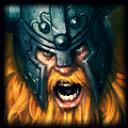
Olaf Skill Order
Normal order: R > Q > E > W. Take R whenever it is available. Max Q first, max E second, and leave W for last in most games. This is the safest default in ARAM: Mayhem because Olaf needs a reliable way to start fights, stick to targets, and punish enemies who step too far forward. Q gives him that access. If Q is weak, Olaf becomes a melee champion asking politely to be kited.
Standard leveling plan
- Early levels: Start Q when your team needs poke, wave control, or a way to check bushes from range. Take E early if the first fight is already guaranteed and you can actually reach a target. Take W early when you expect to be hit constantly before you can all-in, but do not rush it over your damage tools unless the lobby is pure brawling.
- Main max: Max Q first. Q is Olaf’s best normal first max because it gives him the most practical fight access. You use it to slow the first target, force movement, and make the enemy spend disengage before you commit with R. It also helps your team contest the wave instead of waiting under tower while poke champions take free space.
- Second max: Max E second. Once Q is strong enough to let Olaf reach people, E becomes the better follow-up damage. This is the “I got to you, now you have to deal with me” part of the kit. E second is especially important when enemy carries have shields, sustain, or frontliners body-blocking your Q angles.
- Last max: Max W last in the default setup. W is still important, but it usually does not solve Olaf’s biggest ARAM problem by itself. If you cannot reach anyone, extra self-combat power does nothing. If you can reach them, Q and E usually decide whether the fight is won before W value becomes the main issue.
When to keep Q max no matter what
- Enemy team has long range: Max Q first when you are facing poke mages, marksmen, or backline champions who only lose if you force them to move. You need repeated Q pressure to create an angle. If you max E first here, you often spend the early game walking forward, getting slowed or zoned, then backing off with nothing gained.
- Your team lacks engage: Max Q first when your team has damage but no clean starter. Olaf can use Q to mark a target, make them sidestep, and open a Snowball or R angle. If you delay Q in this setup, your team may have to wait for the enemy to make a mistake, which is a bad plan in Mayhem where fights can explode quickly.
- You are the only melee threat: Max Q first when the enemy can focus all peel on you. You need the slow and repeated threat to drain their answers before committing. E-first Olaf into a full peel comp often gets one hit, gets kited, then dies while his team is still too far away to trade.
When E max becomes more attractive
- Enemy team is short range: If both teams are forced to fight in melee and the enemy has to walk into you, consider putting more points into E earlier after Q has enough reliability. You are not chasing as much, so direct combat damage matters more. This works best when your frontline or crowd control already keeps targets near you.
- You have consistent delivery: If your comp has strong engage, displacement, or easy follow-up that puts Olaf on top of the enemy carry, E second becomes mandatory and an earlier E emphasis can be correct. In those games, your job is not to fish with Q forever. Your job is to arrive, hit the priority target, and make the fight impossible for them to reset.
- The enemy front line is the real target: If the enemy carry is unreachable but their tank or bruiser is overextended every fight, E gains value because you are trading directly into someone who cannot avoid you. Still do not completely neglect Q, because you need it to stop that frontliner from leaving when your team turns on them.
When W deserves earlier points
- Permanent brawl lobbies: Put extra points into W earlier when every fight starts at close range and nobody has the damage pattern to kite you cleanly. This happens against multiple melee champions, low disengage teams, or comps that must run into the wave to function. In those games, surviving the first burst and continuing to swing can matter more than extra chase.
- You are being forced to tank first contact: If your team has no other durable champion and you must walk up before anyone else can play, W can be moved up slightly. Do this only when you are actually absorbing damage and getting to hit back. If you are just being poked from outside your range, W points do not fix the real problem.
- You already have enough sticking power from augments or team setup: If your augments, allies, or Snowball access consistently put you on a target, W can be valued earlier because the chase problem is already solved. The trigger is simple: if you are reaching enemies every fight but dying before your second rotation, W is worth earlier investment.
Augment-Influenced Skill Order
Default augment order: R > Q > E > W still holds unless your augments clearly change Olaf’s job. Do not change skill order just because an augment is “good.” Change it when the augment changes what is limiting you in fights: access, burst, durability, or repeated uptime.
Q-focused augment path
Use: R > Q > E > W.
- Choose this when an augment rewards repeated ability use, chase pressure, slows, or ranged setup. Q max becomes even more important because every successful axe angle can start a fight or force a defensive tool. In these games, Olaf plays like a pressure wedge: Q first, walk into the space it creates, then decide whether R is needed.
- Choose this when your augment gives mobility only after contact. You still need Q to make first contact possible. If you skip Q max because you believe the augment will carry your engage, you may never trigger the condition that makes the augment strong.
- Cost of the wrong order: If you go E or W heavy while your augment wants repeated Q pressure, you lose the ability to start fights on your terms. The enemy backline gets cleaner spacing, your Snowball becomes more predictable, and your R often turns into a desperate run instead of a winning commit.
E-focused augment path
Use: R > Q > E > W as the baseline, but shift extra early points into E if access is already solved.
- Choose this when an augment improves single-target finishing, close-range damage, or rewards staying on one champion. Q still needs early investment so you can reach the fight, but E becomes the stat check once you are there. This is strongest when your team can lock targets down or when the enemy comp has to fight in a narrow front-to-back pattern.
- Choose this when enemy carries are not the first target. If you are repeatedly fighting tanks, bruisers, or divers in the middle of the lane, E value rises because the fight is about winning contact, not finding contact. You can still throw Q to slow and reposition, but your kill pressure comes from repeated direct trades.
- Cost of the wrong order: If you over-invest in E without reliable access, Olaf becomes feast-or-famine. You look strong when someone walks into you, then useless when the enemy team respects your range. The punishment window is brutal: they poke you, wait out your approach, and peel the moment you press forward.
W-focused augment path
Use: R > Q > W > E only when the lobby and augments both demand extended brawling.
- Choose this when an augment rewards durability, sustained combat, or low-health fighting and you are actually allowed to keep attacking. W second can be correct when fights last long enough for Olaf to profit from staying in the middle. It is not a poke answer. It is a brawl answer.
- Choose this when your team already has enough damage but needs a champion to keep the enemy busy. If your carries win when the enemy spends cooldowns on you, W second helps you buy that time. The action pattern is simple: Q to enter, R through the key control, W during the committed trade, and force the enemy to either kill you slowly or ignore you while you hit their backline.
- Cost of the wrong order: W second is bad when the enemy can disengage. You become harder to kill for a moment, but not harder to kite. If the enemy backs up, slows your team, and waits out your commit, you paid skill points for a fight that never really happened.
Practical Rule
If Olaf is struggling to reach enemies, max Q. If Olaf is reaching enemies but not killing them, max E second and consider earlier E points. If Olaf is reaching enemies and dealing enough damage but dying before the fight turns, move W up. The wrong order usually fails by solving the wrong problem: E does not help a kited Olaf, W does not help a zoned Olaf, and Q does not fully replace combat stats when the fight is already glued to your face.