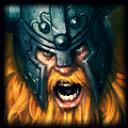
Passive - Berserker Rage
Function: Olaf gets more dangerous as his health drops. His passive rewards him for staying in the fight instead of backing out the moment he is low, giving him the sustained damage profile that makes him scary in messy ARAM: Mayhem brawls.
- Mayhem use: Treat low health as a power window, not a panic signal. If your W is ready, your axe is on the ground nearby, and the enemy has already spent their burst, you can keep swinging and often win fights that look bad on the health bar.
- Targeting or hit logic: The passive does not need a target decision by itself, but it changes which targets you can commit to. You want extended contact with champions who cannot instantly kite away or finish you through your sustain.
- Combo role: Passive is the reason Olaf combos are not just one rotation. Q gets you in, E adds reliable damage, W helps you survive the dangerous part, and passive makes every extra auto attack matter more.
- Early fight use: In early bridge fights, do not blow all your tools at full health unless your team is ready to follow. Trade forward, take some damage, then use the missing-health power spike to force the second half of the fight.
- Teamfight use: In full fights, passive shines when you pick one reachable target and refuse to be peeled off. If you swap targets constantly, you waste the value of staying in auto range while low.
- Counterplay: Enemies punish Olaf by disengaging when he drops low, using slows before his R, or saving burst until after W. They do not need to duel you fairly; they just need to deny your extended contact.
- Leveling priority: You do not level the passive, but your skill order should support it. Q and E increase your ability to stick and threaten, while W is the safety button that lets the passive actually do work.
- Punishment for wasting it: If you retreat the moment you get low while your cooldowns are available, you give up Olaf's strongest damage window. If you stay low without W, R, or a nearby axe, you are not brave; you are just collectible gold.
Q - Undertow
Function: Olaf throws an axe that damages and slows enemies, then lands on the ground. Picking it up lets him throw again sooner, so the spell is both poke and chase engine.
- Mayhem use: Q is your most important button in ARAM: Mayhem because the mode creates constant front-to-back contact. Throw it where the enemy must walk, not only where they are standing. A good axe makes them choose between eating the slow or giving up space.
- Targeting or hit logic: Aim through the frontliner toward the champion you actually want to reach. Shorter throws are easier to retrieve and better for all-ins. Long throws are useful for starting a fight or checking a clumped wave, but they are risky if the axe lands behind enemy control.
- Combo role: Q starts most Olaf sequences. Q slow, walk in, auto, E, pick up axe, Q again. If you have Snowball or another engage tool available, land Q first when possible so the enemy is slowed before you commit your body.
- Early fight use: Early on, use Q to punish enemies who step up to hit minions or poke your backline. Do not spam max-range axes into nothing. If you cannot pick the axe up safely, you are paying a real tempo cost.
- Teamfight use: In teamfights, Q decides whether Olaf is a champion or a slow melee minion. Throw it along your chase path so you can collect it while moving forward. If you throw sideways or too deep, you may lose the reset path and get kited.
- Counterplay: Enemies will stand away from the axe landing spot, drop zone control on it, or bait you into walking too far forward for the pickup. Good players also sidestep the first axe and punish while it is down.
- Leveling priority: Max Q first in most Mayhem games. It gives Olaf his most reliable access to fights, his best repeated pressure, and the clearest way to punish immobile carries.
- Punishment for wasting it: Missing Q before you ult is brutal. Without the slow, enemies can kite out your R window, force you to chase in a straight line, and make your W expire before you have done meaningful damage.
W - Tough It Out
Function: Olaf gains a defensive burst and improves his ability to keep fighting. It is not just a shield button; it is the spell that lets him survive the moment when enemies finally turn on him.
- Mayhem use: Hold W until damage is actually coming. In Mayhem, fights are chaotic and there is constant chip damage, but pressing W for light poke is a common mistake. Save it for the commit, the counter-burst, or the moment you drop low and still have targets in reach.
- Targeting or hit logic: W does not require aiming, so the skill is timing. Use it when you are already hitting or about to hit. If you press it while walking through slows with no target nearby, you waste the part of the spell that lets you fight back.
- Combo role: A strong all-in often looks like Q to slow, R to ignore control when needed, then W once the enemy team starts focusing you. Pressing W too early announces your plan and gives them time to disengage.
- Early fight use: In early skirmishes, W can flip a close melee trade. Let the enemy commit first, then activate W and keep attacking. If you use it before they spend damage, they can simply wait it out and re-engage after.
- Teamfight use: In teamfights, W is your recovery plan after the first wave of burst. If your health drops but your passive is active, W can buy enough time to finish a carry, force defensive summoners, or retreat behind your frontline after securing damage.
- Counterplay: Enemies should kite during W, apply anti-healing effects when available, and avoid feeding Olaf free attacks while he is low. Burst champions will often hold their biggest damage until W is gone.
- Leveling priority: Level W after Q and E in most games. One point gives the key survival pattern, while extra points are usually less important than stronger axes and stronger single-target threat.
- Punishment for wasting it: If W is down, you cannot safely abuse low health. The enemy can poke you, disengage your passive window, then burst you when you try to re-enter.
E - Reckless Swing
Function: Olaf strikes a target for reliable direct damage and pays a health cost if the target survives. It gives him a dependable way to finish enemies who are already in his face.
- Mayhem use: E is excellent in Mayhem because fights often collapse into short melee piles. Use it on the target your team can actually kill, not automatically on the closest tank unless the tank is the only reachable champion.
- Targeting or hit logic: E is targeted, so it does not miss like Q, but you still need range. Walk in with Q slow, Snowball follow-up, or R movement pressure before using it. If you flash or dive only to E once and die, the trade is rarely worth it unless it secures a key carry.
- Combo role: E is the execution pressure inside your chase loop. Q gets contact, autos keep pressure, E forces the enemy health bar down, then another Q or auto chain keeps them from escaping.
- Early fight use: Early, use E when the enemy cannot immediately punish the health cost. If you are already being focused by multiple champions, careless E casts can help finish yourself before your passive and W matter.
- Teamfight use: In teamfights, E should land on priority targets when possible. If a carry is slowed and within reach, spend E there. If not, use it to shred the frontline while keeping your axe pickup path safe.
- Counterplay: Enemies punish E by spacing just outside Olaf's reach, forcing him to take poke before contact, or baiting him into using it on a durable target while the backline steps away.
- Leveling priority: Max E second in most games. After Q gives you access, E gives you the threat that makes enemies respect your all-in instead of simply walking through your damage.
- Punishment for wasting it: Using E on the wrong target can lose the fight. You spend health, lose finishing pressure, and may give the enemy carry enough time to kite your R or wait out your W.
R - Ragnarok
Function: Olaf breaks into his all-in state, ignoring crowd control during the active and gaining the freedom to run at enemy champions. This is the ability that turns him from a kiteable bruiser into a backline problem.
- Mayhem use: R should answer a real obstacle. Use it when control effects would stop your engage, when a slowed carry is reachable, or when your team is already moving with you. Do not press it just because a fight started somewhere on the screen.
- Targeting or hit logic: R has no skillshot, so target selection is everything. Pick a champion you can stay near. If the enemy backline is too far and protected by terrain, minions, or zone control, it may be better to ult through the frontline and win the closer fight first.
- Combo role: The clean pattern is Q before R if possible, then R to ignore peel, W when damage lands, E when in range, and repeated axes to maintain contact. If you ult before landing any slow, fast champions can simply run until your pressure fades.
- Early fight use: At the first ult fights, be patient. Let enemies show their root, stun, knockup, or heavy slow, then activate R to deny the peel and punish the overstep. If they have no control left, you can sometimes save R and win with Q chains.
- Teamfight use: In full fights, R is either your engage permission or your anti-peel tool. If your team has follow-up, you can start with it. If your team lacks reach, wait for an enemy carry to step forward, land Q, then ult so your commitment has a real target.
- Counterplay: Enemies beat Ragnarok by disengaging, spreading out, using terrain and movement tools, or waiting to burst after Olaf has crossed too much distance. Since R does not make bad positioning safe forever, they can kite backward and punish once he is isolated.
- Leveling priority: Put points into R whenever available. It defines Olaf's best fights and lets his normal abilities function against teams that rely on crowd control.
- Punishment for wasting it: A wasted R is Olaf's biggest punish window. If you ult into no target, miss Q, or chase too far from your team, the enemy can reset, turn with control after the threat passes, and kill you before your next real engage.