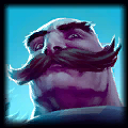
Mayhem vs ARAM Comparison: Braum
In normal ARAM, Braum is a patient defensive warden. You hold E, walk forward to threaten Q, and look for passive stuns on overextended enemies. Mayhem turns that patient style into a liability. The mode's accelerated gold, reduced death timers, and augment power mean standing around waiting for the perfect engage loses you the lane. You either play aggressive or you get run over.
Role Shift: From Passive Warden to Active Playmaker
Standard ARAM Braum often plays second fiddle to a carry. You peel, you block, you occasionally flash-R. Mayhem demands more initiative. Augments can turn your passive into a team-wide stun engine or give your R enough uptime to zone entire fights. You're not just protecting someone anymore—you're creating the windows your team exploits. If you play purely reactive, the enemy team's augments will overwhelm your shield before you get a chance to respond.
Skill Use and Order Changes
- Passive priority rises. In normal ARAM, you often max Q first for poke and slow duration. Mayhem's faster fights mean the passive stun becomes your primary win condition. Any augment that adds stacks, extends stun duration, or spreads marks to nearby enemies turns basic attacks into lethal setup. You want W second for the resistances and E last—shorter fights mean the shield's uptime matters less than surviving the initial burst.
- Q becomes a setup tool, not poke. The reduced heal and shield power in Mayhem makes attrition less relevant. Throwing Q to chip damage is a waste; throw it to apply passive marks before your ADC autos, or to slow a diver so your team can collapse. Accuracy matters more than volume.
- E timing tightens. In normal ARAM, you can hold E for extended trades. In Mayhem, burst windows are instant. If you react late to a Syndra R or a Jinx super-mega-death-rocket, you're dead before the shield raises. Pre-emptive blocking on obvious windups becomes necessary, especially against augmented abilities that hit harder than you expect.
- R is a fight-starter, not just a disengage. Lower cooldowns from ability haste augments mean you can throw R to start a skirmish, not just save it for the perfect five-man. A two-man knockup that your team can follow is worth more than holding R for a defensive play that never comes.
Tempo and Death Timer Pressure
Normal ARAM has long death timers early. A bad trade at level 3 can cost your team the tower. Mayhem's reduced timers mean dying to make a play isn't catastrophic—you respawn fast enough to defend. This shifts Braum's risk calculus. You can afford to flash-W into a marked enemy for a stun, or body-block a lethal ability to save a carry, because your absence won't lose the game. The mode rewards calculated aggression over preservation.
What kills you is dying for nothing. Walking up to "apply pressure" without a plan, taking free poke, or shielding damage your team could have dodged—these waste your respawn advantage. Every death needs to create space, burn enemy cooldowns, or secure a kill.
Augment Impact on Playstyle
Augments distort Braum's kit more than most champions. A passive-focused augment can make your basic attacks the most dangerous part of your team's engage. An ability haste augment turns R from a once-per-fight tool into something you cast twice in a prolonged skirmish. A durability augment lets you stand in places normal ARAM Braum can't—directly in front of an enemy turret to block a siege, or in the middle of their team to absorb a burst combo.
The trap is building around augments that don't match the game state. If your team lacks damage, taking defensive augments and playing passive loses. If the enemy has heavy poke, taking aggressive augments and diving without a frontline loses. Read the lobby, read your augments, and adapt. A Braum with a damage augment still isn't a carry—use the extra threat to force respect, not to duel people.
Snowball Use: More Aggressive, Less Defensive
In normal ARAM, Braum often saves Snowball for disengage or to gap-close after a teammate's engage. Mayhem's faster pace means holding Snowball is often a mistake. You throw it to start fights, to force the enemy to respect your engage range, or to mark a squishy target for your team's burst. The mark itself applies pressure—enemies have to reposition or eat the follow-up.
Defensive Snowball still has value, but the window is tighter. If an assassin jumps your carry, Snowballing away is often too slow. You're better off using W to jump to the carry, E to block the follow-up, and Q to slow the diver. Snowball becomes your escape only when you're the one getting collapsed on.
Item and Rune Logic Adjustments
Normal ARAM Braum builds for sustain and attrition: Guardian, Revitalize, Moonstone or Locket, with a focus on extended fights. Mayhem's burst-heavy environment makes that build too slow. You want resists and active items that do something immediately. Locket is still good, but Knight's Vow, Zeke's, and even offensive support items like Imperial Mandate (if your augment supports it) become more attractive. The goal is to survive the first three seconds of a fight and provide utility while your damage dealers work.
Runes shift toward durability and engage. Aftershock becomes stronger when you're constantly jumping into enemies with W. Font of Life pairs well with passive-focused augments. Guardian is still playable, but only if your team has a single carry you're dedicated to protecting—otherwise, the rune doesn't trigger enough in Mayhem's chaotic fights.
Teamfight Spacing: Closer Than You Think
Normal ARAM Braum plays at mid-range, close enough to shield but far enough to disengage. Mayhem forces you closer. The threat range of augmented abilities means standing at your max Q distance often puts you outside shield range for your backline. You need to be near your carry, ready to W-E on reaction, because the time between "enemy starts ability" and "enemy completes ability" is shorter than your travel time.
At the same time, don't stack on top of your team. Augmented AoE abilities can wipe grouped teams. Your job is to be close enough to react, but not so close that you eat a crossfire meant for your squishies. It's a narrow band of positioning that changes based on enemy threat profiles—learn where each champion's danger zone ends and stand just inside your shield range of it.
ARAM Habits That Fail in Mayhem
- Waiting for the perfect R. Normal ARAM rewards patience with big ults. Mayhem rewards frequency. A mediocre R that lands now is better than a perfect R that never happens because you died waiting.
- Playing for sustain. Poking, backing off, healing up, repeating—this cycle doesn't work when death timers are short and gold flows fast. The enemy isn't trying to attrition you; they're trying to kill you. Play like it.
- Overvaluing shield uptime. In normal ARAM, holding E for the right moment is correct. In Mayhem, the right moment is often "now" because the next burst is already incoming. A shield that blocks 70% of a spell is better than no shield because you waited for the perfect block.
- Trusting your passive to do the work. Without augments, Braum's passive is strong but slow. In Mayhem, enemies have tools to cleanse, dash, or burst you before the fourth auto lands. You need to layer your CC—Q slow into passive stun into R knockup—so they can't escape the chain.
- Ignoring augment power spikes. A level 6 Braum in normal ARAM is a moderate threat. A level 6 Braum with a tier 2 augment in Mayhem can be a teamfight winner if you play around it. Check your augments, check the enemy's augments, and respect the power differential.
The core adjustment is simple: stop playing like a passive observer and start playing like an active participant. Mayhem doesn't reward wardens who wait for trouble—it rewards wardens who create trouble for the enemy first. Block what matters, stun who you can, and don't be afraid to die if it means your team wins the fight.