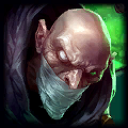
Singed Skill Order
Normal order: R > Q > E > W. Take Q early, put one point in E for the flip, add W once fights start needing zone control, then max Q first, E second, W last. Level R whenever it is available.
Standard leveling plan
- Start Q when both teams are still poking and posturing. You need Poison Trail running through the wave and around melee entrances so enemies pay health for walking forward.
- Take E second if your team can punish a flipped target, or if an enemy carry is stepping too close to clear. One clean E into your team is often better than chasing for extra poison.
- Take W third once enemies start using dashes, Snowball follow-ups, or hard engage to force fights. Even one point gives you a way to make a zone awkward before you run in or after you retreat.
- Max Q first. Singed needs constant area damage to matter in ARAM: Mayhem. If Q is under-leveled, you run through people and they simply ignore you.
- Max E second. After Q is strong enough, E gives your all-in and peel patterns more bite. It also makes every overstep more punishable when an enemy walks past the minion line.
- Max W last in the normal setup. W is still useful, but Singed usually gets more from stronger poison and stronger flip pressure than from rushing the zone tool.
Why Q max is the default
Q is the main max because Singed wins by making space expensive. In Mayhem, teams group quickly, fights restart often, and enemies do not always get clean resets after taking chip damage. A high-rank Q lets you clear waves while threatening anyone who chases, and it turns narrow bridge fights into bad trades for the enemy team.
If you are ahead, Q max lets you stand between the enemy team and the wave. If you are behind, Q max is still your best recovery tool because you can farm, stall, and punish dives without needing to land a perfect engage. When Q is delayed, Singed becomes too dependent on E picks. That is risky. If the flip target has peel, cleanse-style help, or enough burst behind them, you walk in and give the enemy a clean punish window.
Why E is usually second
E second is for kill conversion. Once your Q damage is online, your next problem is making enemies stay in bad positions long enough for your team to hit them. E gives you that moment. Use it when a carry walks too far forward, when a diver crosses past you, or when your backline needs someone peeled away immediately.
Second-max E also fits Singed's best rhythm: poison the path, threaten the angle, then flip the player who disrespects your movement. If your team has burst, traps, knockups, or reliable follow-up, E second becomes even better because every flip can start a real fight instead of just being a small displacement.
When W can move up earlier
Do not usually max W second, but add points earlier when the enemy team is winning through movement. If they have multiple dash-heavy carries, Snowball divers, reset champions, or engage tools that keep bypassing your front line, earlier W ranks can be justified. The goal is not to top damage. The goal is to ruin the enemy's entry timing so your team can hit them before they reach your carries.
Move extra points into W before finishing E if fights are being decided by one fast engage every time. Put W where the enemy wants to land, not where they already were. If you drop it late, they have already spent their movement and your team is already under pressure. If you drop it early, you force a choice: they either wait and lose tempo, or they enter through a bad zone and get flipped or focused.
Augment-influenced skill order
- Poison damage, burn, area-control, or extended-fight augments: stay with R > Q > E > W. These augments reward time spent near enemies, so Q max first is non-negotiable. Your job is to keep the fight messy, drag enemies through poison, and make every chase cost health.
- Durability, healing, shield, or tank-fight augments: still max Q first, then choose E second unless your team is losing only to mobility. Surviving longer does not help if your poison is too weak to matter. Tanky Singed needs threat, not just health.
- Flip, displacement, single-target punish, or pick-focused augments: use R > Q > E > W, but you can put an earlier second point into E if your team has immediate follow-up. Do not skip Q max completely. E-focused Singed without Q pressure flips someone once, then has little damage while waiting for the next opening.
- Slow, zone, anti-mobility, or trap-style augments: consider R > Q > W > E only when enemy mobility is the main reason you are losing fights. This is the anti-dive order. You trade some flip threat for better control around entrances, relic areas, and your backline.
- Snowball-engage or run-at-them augments: keep Q first, E second. You need Q damage while moving through the enemy team, and E gives you the payoff when you reach the right target. W can be taken earlier for setup, but it should not replace your main damage unless the enemy team is impossible to pin down.
- Pure utility or support-style augments: do not overcorrect into W max unless your team already has enough damage and only needs peel. Singed with low Q ranks becomes a walking nuisance instead of a real threat, and good enemies will ignore you until your carries are dead.
Adjustment triggers during the game
- If enemies chase you every fight: max Q first and do not delay it. Their mistake is following your path. Make that mistake hurt.
- If enemies refuse to chase and only poke: Q still comes first for wave control, but E second becomes more important so you can punish the first player who steps too far forward.
- If your backline is being jumped: add an earlier W point and look for E as peel, not engage. Stand near your carries instead of sprinting behind the enemy team every fight.
- If your team has strong follow-up crowd control: E second is high value. Flip the target into the follow-up, then run a poison path across their retreat.
- If your team lacks damage: never rush W. You need Q ranks to contribute meaningful pressure, or your team will lose long fights even when you survive.
- If the enemy has several slippery carries: W second can be considered, but only if those carries are actually escaping every engage. If they are dying when flipped, E second remains better.
Cost of the wrong order
Wrongly delaying Q is the biggest mistake. You lose wave control, your chase damage drops, and enemies can walk through your space without caring. Singed then has to force risky flips to stay relevant, which gives the enemy team clear chances to burst him when he crosses too deep.
Maxing W too early without a mobility problem also hurts. You may feel useful because the zone looks impactful, but if enemies are not being stopped by it, you gave up damage and kill pressure for a tool they can simply wait out or walk around. In that game state, stronger Q and E would have punished them harder.
Ignoring E for too long makes your pressure toothless. Q makes enemies uncomfortable, but E turns discomfort into a kill or a saved teammate. If E is left too low while your team needs picks, carries will step forward, clear the wave, and retreat before you can punish them properly.
Best default: R whenever possible, Q max first, E max second, W last. Shift points toward W only when enemy movement is the real problem. Singed is at his best when the enemy has no good choice: chase him and bleed, ignore him and lose space, or step too close and get flipped into his team.