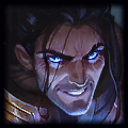
Sylas Detailed Ability Guide
Sylas is a brawling AP skirmisher who wins Mayhem fights by entering at the right angle, stealing a high-value ultimate, and chaining short bursts of damage with healing and mobility. He is not a clean front-to-back mage. If he spends E or W too early, he becomes very punishable. If he waits for enemy crowd control to miss, he can take over messy ARAM: Mayhem fights quickly.
Passive - Petricite Burst
- Function: After Sylas casts an ability, his next basic attacks become empowered and deal area damage around the target. This is the glue in his damage pattern. His spells start the trade, but the passive attacks finish it.
- Mayhem use: In constant lane fighting, use the passive to punish grouped enemies after every spell cast. If the enemy team stacks in the minion wave or around a low-health ally, step in, cast, and weave an empowered attack before using the next spell.
- Targeting and hit logic: The empowered attack still needs Sylas to be in attack range, so do not treat it like free damage. Hit the closest safe target when diving is risky. If a carry is just outside reach, hitting a frontline champion can still splash value into nearby enemies.
- Combo role: Passive weaving separates good Sylas players from button mashers. A clean pattern is spell, attack, spell, attack, then decide whether W is needed for sustain or E is needed to chase. Skipping passive attacks lowers your damage and often leaves enemies alive long enough to kite you.
- Early fight use: Early on, use passive procs mostly after Q or E1 to trade through minions without overcommitting. Do not walk past the wave just to land one empowered hit if the enemy still has hard crowd control ready.
- Teamfight use: In full fights, passive attacks are best used while moving between targets. Hit whoever is reachable after each spell, especially when your stolen ultimate or E has already forced enemies to clump.
- Counterplay: Enemies punish passive reliance by spacing out, slowing Sylas before he can attack, or disengaging after his first spell. Champions with knockback or silence can break his rhythm before he gets multiple empowered hits.
- Leveling priority: Passive is not leveled directly, but its value rises with ability uptime and AP. The more often Sylas can cast, the more often he can threaten these empowered attacks.
- Punishment for wasting it: If Sylas casts several spells without weaving attacks, he burns resources for mediocre damage. In Mayhem’s fast fights, that usually means the enemy survives your engage and turns on you while your key tools are unavailable.
Q - Chain Lash
- Function: Sylas lashes his chains in a targeted area, damaging enemies in crossing lines and then threatening a delayed follow-up at the intersection. It is his safest poke, wave control, and setup tool.
- Mayhem use: Use Q to soften targets before committing. In ARAM: Mayhem, enemies often stand near minions, portals of action, or narrow choke points, so a well-placed Q can tag multiple champions without forcing Sylas into danger.
- Targeting and hit logic: Aim Q where the enemy wants to move, not only where they are standing. The first hit is easier to land on slowed, stunned, or body-blocked targets, while the delayed center rewards prediction or allied crowd control.
- Combo role: Q can start a trade before E, or it can be saved after E2 when the enemy is locked into a movement path. If you land E2 on a priority target, placing Q immediately under them makes the delayed damage much harder to avoid.
- Early fight use: Early, Q is your safest way to contribute while waiting for a real engage. Cast it through the wave when enemies walk up to last-hit or poke. If you miss, back off until your next spell cycle rather than forcing E into five ready opponents.
- Teamfight use: In teamfights, Q is best when enemies are already slowed, trapped by terrain, or distracted by your frontline. Do not tunnel on hitting the backline if placing Q on two frontline champions creates a safer passive window.
- Counterplay: Enemies can sidestep the delayed center, spread away from the intersection, or bait Q before walking forward. Mobile carries will often dodge the second part unless you combine it with E, an ally’s control, or a stolen ultimate.
- Leveling priority: Q is often a strong early investment when Sylas needs poke and wave interaction, but its priority depends on whether you need safer damage or stronger all-in sustain. If fights are short and brawly, W may take priority sooner.
- Punishment for wasting it: Missing Q removes your safest pressure. If Q is down, enemies can walk up more confidently, and Sylas may feel forced to engage with E without having softened anyone first.
W - Kingslayer
- Function: Sylas lunges to a nearby enemy, deals damage, and heals himself. It is his most important close-range trading button and his main way to survive after entering.
- Mayhem use: W is the spell that lets Sylas stay in fights longer than enemies expect. Hold it until you are actually taking return damage or need the short lunge to finish a target. Casting it at full safety often wastes its best value.
- Targeting and hit logic: W requires an enemy in range, so positioning matters. You can use frontline champions as a sustain anchor when diving the backline is impossible. If the carry is too far, W the tank, heal, and keep moving rather than dying for a low-odds reach.
- Combo role: In an all-in, W usually comes after E2 or after a passive attack, when Sylas is already inside the enemy team. In shorter trades, Q poke into W can punish someone who steps too close, then E can be held as the escape or follow-up.
- Early fight use: Early fights are dangerous because Sylas can be focused down before W gets full value. Use it to punish overextended melee champions or to recover after taking poke, but do not W forward if the enemy backline still has all control spells ready.
- Teamfight use: In teamfights, W is your reset point. Enter, spend damage, then W when enemies commit to killing you. If you use W too early, the enemy only has to wait out your heal and burst you during your retreat.
- Counterplay: Grievous Wounds, burst damage, kiting, and displacement all reduce W’s impact. Enemies should keep Sylas at arm’s length and avoid giving him a low-health target to lunge onto during the middle of a fight.
- Leveling priority: W is commonly prioritized when Sylas is playing as a bruiser and expects repeated close-range fights. If your team needs you to survive engages and clean up, W levels are extremely valuable.
- Punishment for wasting it: A wasted W is one of Sylas’s biggest punish windows. If he uses it on a poor target, at the wrong health point, or before enemy burst lands, he loses his main recovery tool and can be collapsed on immediately.
E - Abscond / Abduct
- Function: Sylas dashes once, then can recast to throw his chains in a line, pulling himself to the first enemy hit and applying crowd control. This is his engage, escape, gap-close, and pick tool.
- Mayhem use: E decides whether Sylas is a threat or a free kill. Use the first dash to dodge skillshots, reposition behind minions, or create an angle. Use the second cast only when a hit creates real value, because missing it leaves you exposed.
- Targeting and hit logic: E2 stops on the first enemy hit, so minions, frontline champions, and summoned units can block the target you want. Look for side angles instead of throwing it straight through the wave. If a tank is intentionally body-blocking, hitting them can still be fine if your team is ready to follow.
- Combo role: E1 into E2 is the classic entry, followed by passive attack, Q, W, and another passive attack. You can also use E1 backward after trading with Q and W, saving E2 as a deterrent against enemies chasing you.
- Early fight use: Early, E should be used with discipline. If enemy poke or crowd control is still available, hold E1 to dodge instead of forcing a low-percentage chain. A missed E2 often means you cannot trade back or escape.
- Teamfight use: In teamfights, E2 is best used after someone else starts the fight or after an enemy carry has used mobility. If you engage first, aim from fog, from the side, or after a stolen ultimate creates chaos. Straight-line engages into five champions are easy to punish.
- Counterplay: Enemies can stand behind minions, sidestep the chain, interrupt Sylas after he enters, or save disengage for his second cast. If Sylas misses E2, immediately pressure him before W and passive attacks let him stabilize.
- Leveling priority: E gains value when Sylas needs more frequent engage threat and stronger pick pressure, but it is usually balanced against W sustain and Q poke. Level it with your role in mind: catcher, bruiser, or poke-follow-up.
- Punishment for wasting it: Wasting E removes both your best engage and your best escape. In Mayhem, that is often fatal. A Sylas with E down can be kited, rooted, or forced to Flash defensively instead of choosing the fight.
R - Hijack
- Function: Sylas steals an enemy champion’s ultimate and can cast it himself. This gives him flexible engage, burst, peel, sustain, or utility depending on the enemy team.
- Mayhem use: R is the reason Sylas can swing games. Before each fight, identify the best stolen ultimate for the next situation, not the flashiest one. A reliable engage or defensive tool often wins more fights than a high-damage ultimate you cannot land.
- Targeting and hit logic: Hijack targets an enemy champion, then Sylas uses that champion’s ultimate according to its normal targeting style. If the stolen ultimate is a skillshot, you still need the angle. If it is a self-buff or area tool, you need to enter at the right timing.
- Combo role: Stolen ultimates can start the fight, extend the fight, or finish the fight. Engage ultimates pair well with E follow-up. Damage ultimates work best after E2 or allied crowd control. Defensive ultimates should be held until the enemy commits, not thrown out during poke.
- Early fight use: Early after unlocking R, take the ultimate that gives your team the clearest fight plan. If your team lacks engage, steal engage. If your carries are being dove, steal peel or disruption. Do not greed for a backline ultimate if you cannot safely reach its owner.
- Teamfight use: In teamfights, use R with a plan before you go in. Steal from the safest target you can access, then choose the moment when enemies cannot simply walk away. A stolen crowd-control ultimate is strongest when your team is close enough to damage the controlled targets.
- Counterplay: Enemies can deny Sylas by spacing the best ultimate holder away from him, forcing him to steal a weaker option, or baiting him into using a stolen ultimate before the real fight starts. They can also punish him while he moves forward to hijack.
- Leveling priority: Level R whenever available. Its value scales with decision-making as much as raw power, because the correct stolen ultimate changes from fight to fight.
- Punishment for wasting it: A bad Hijack can lose the whole fight. If Sylas steals the wrong ultimate, casts it into disengage, or uses it before allies can follow, he loses his biggest advantage and becomes a shorter-range AP bruiser waiting for basic cooldowns.