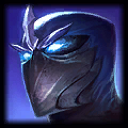
Shen Skill Order
Normal order: R whenever possible, then Q > E > W. Max Q first when you need Shen to actually win short trades after he goes in. Q is the button that makes your taunt matter; if you land E but your Q is under-leveled, the target often walks out after the crowd control ends and your team has to spend extra damage to finish a fight you already started.
Second max E in the standard setup. Shen needs reliable access to targets in Mayhem because fights break open fast and missed engage windows get punished hard. More E priority makes your engage pattern cleaner: look for a target stepping past their frontline, E through them, pull Q into the fight, then use W to cover the counter-hit. If your team has damage but no way to start, E second is usually the difference between a real pick and Shen just standing in front waiting to be ignored.
Max W last by default. W is still important, but it is usually a timing skill rather than a damage plan. Put a point in it early so you can deny key basic-attack windows around your blade, then save it for the moment enemies commit onto you or your carry. If you level W too heavily without a reason, you often lose the pressure that Q and E give you, and Shen becomes a walking delay tool instead of a champion who can force a fight.
Normal Skill Priority
- R > Q > E > W when your team needs Shen to frontline, punish oversteps, and still have enough damage to matter after the taunt.
- Start with Q and E access as soon as possible. Q gives your trades a point, E gives your team a way to catch someone. Add W early once enemies can punish your engage with basic attacks or dive your backline.
- Take R whenever it is available. Shen’s ultimate is your map-wide style rescue tool even on the single lane: use it when a carry is being collapsed on, when another diver commits first, or when shielding an ally lets you arrive into a winning counter-fight.
Augment-Influenced Skill Order
- Q-focused augments: R > Q > E > W. If your augments reward repeated attacks, close-range fighting, sustained trading, or personal damage, stay on Q max. Your job is to taunt, stick, and make every empowered trade hurt. Do not get baited into defensive leveling if the augment is asking you to be a damage threat.
- Engage or crowd-control augments: R > Q > E > W, with early extra E points if your team lacks initiation. If the augment makes your engages more valuable, E becomes the skill you cannot afford to leave weak for too long. You can still max Q first unless your team already has more than enough damage and only needs you to create catches. In that case, shifting earlier into E is fine.
- Tank, protection, or anti-dive augments: R > Q > E > W in most games, or R > Q > W > E when W is clearly deciding fights. Choose W second only when enemies rely heavily on basic attacks, your carries are being jumped every fight, or your augment directly rewards defensive zone play. The action is simple: hold your W until the enemy commits, drop it around the ally they are trying to kill, then counter-engage with E instead of wasting E first.
- Ultimate or shielding augments: still take R whenever possible, but do not automatically change the basic max order. If the augment makes your saves stronger, your decision-making changes more than your leveling does. Watch the ally most likely to be burst, use R before they are already dead, then arrive and E the nearest threat. Q and E still give you the fight presence after the shield lands.
- Full peel setup: R > E > Q > W only when your team has a hard carry and you are not expected to deal damage. This is a narrow adjustment. Pick it when your marksman or mage is the whole win condition and enemies are diving them every wave. The cost is obvious: you give up a lot of Shen’s personal threat, so your team must actually kill the targets you taunt.
Adjustment Triggers
- Max Q first when fights are scrappy and you are trading often. If enemies keep walking into melee range or your team follows your taunt quickly, Q levels convert those openings into kills.
- Put more priority into E when missed engage windows are losing the game. If enemies are kiting back, your carries cannot start fights, or every fight begins with your team being poked down, E priority gives you a clearer way to force contact.
- Move W up when enemy basic attackers are the main damage source. If the same champion is winning fights by hitting through your frontline or diving your backline, earlier W value can shut down the exact moment they need to deal damage.
- Do not over-level W against poke-heavy teams that are not committing. W does not solve every ranged spell pattern. Against teams that chip you down and disengage, you usually need Q threat and E catch pressure more than extra defensive investment.
- If your team has no follow-up, favor Q over pure engage leveling. A longer or more frequent engage pattern does not help if nobody can punish the target. In those games, Shen needs enough Q pressure to make enemies respect him even when allies are late.
Cost of the Wrong Order
- Wrongly delaying Q makes Shen harmless after engage. You may land E, but enemies survive the trade, turn on you, and force your team to spend cooldowns defensively. This is the most common way Shen falls behind in tempo.
- Wrongly delaying E makes your team passive. If you max for damage while your team has no starter, you can end up with strong trades that never happen because enemies simply stay out of range and poke you down.
- Wrongly rushing W makes you too easy to ignore. Defensive value is useful only when it blocks the damage that matters. If enemies are not committing into your W, they will wait it out, hit someone else, or kite you while your lower Q and E pressure gives them time.
- Changing order for an augment without reading the enemy comp is a trap. A defensive augment does not mean W second every game, and an engage augment does not mean E first every game. Level the skill that fixes the actual fight: damage if targets live, engage if targets escape, W if your carry dies to basic-attack pressure.
Default to R > Q > E > W. Break from it only when the augment and the enemy pattern both point the same way. Shen is strongest when his skill order matches his job in the fight: Q to make the taunt hurt, E to create the fight, W to deny the punish, and R to turn an ally’s bad moment into your team’s engage.