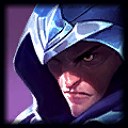
Passive - Blade's End
Function: Talon marks enemy champions when he hits them with his damaging abilities. When enough marks are stacked, his next basic attack on that target triggers a heavy bleed. This is the core of his kill pattern, so Talon is not just “press buttons and leave.” He wants ability hits first, then a clean auto attack to cash out the damage.
Mayhem use: In ARAM: Mayhem, fights are crowded and targets often clump around the wave. That helps Talon land multiple ability hits, but it also makes the finishing auto dangerous. Look for enemies who have already used peel, dashes, or crowd control. If you dive before those tools are gone, you may stack the passive and still die before you can trigger it.
- Targeting and hit logic: Track which enemy has been hit by your W blades, Q, or R blades. Do not spread your spells across three different champions unless you are only poking. For a kill, focus one target until the passive is ready, then step in for the basic attack.
- Combo role: Passive is the payoff of most Talon combos. A common pattern is W into Q, then auto if the target is marked enough. R can either add the last mark or hide your approach so you can finish the auto safely.
- Early fight use: Early in the game, do not force passive procs into full enemy health bars unless your team can follow. Use W to fish for marks, then punish a low-health target who walks too far forward.
- Teamfight use: In larger fights, choose one priority target and commit only when you can reach them. If you mark a tank by accident, do not tunnel through the frontline just to trigger the bleed. Reset your angle and wait for a better target.
- Counterplay: Enemies can deny Talon by backing away after being marked, using crowd control as he steps in, or staying behind allies so his auto attack window is unsafe.
- Leveling priority: The passive does not level directly, but your spell ranks matter because they make it easier and more rewarding to set up kills. Maxing your main damage tools gives the passive more threat.
- Punishment for wasting it: If you fail to trigger the passive after spending W, Q, or R, your burst drops hard. You become a short-range melee champion standing near five enemies with no clean exit.
Q - Noxian Diplomacy
Function: Q is Talon’s direct single-target strike. When used from range, he dashes to the target before hitting them. When already close, it becomes an immediate melee attack. It also helps Talon secure kills, but its biggest value is giving him reliable access to the target he has already prepared with marks.
Mayhem use: Because ARAM: Mayhem fights happen in a narrow lane, Q is both a gap closer and a liability. It puts you exactly where the enemy wants to aim their retaliation. Use it after a target is slowed, distracted, or already missing key defensive tools. If you Q first into a full team, you are offering yourself up before your damage is ready.
- Targeting and hit logic: Q targets a specific enemy. Make sure the target is the champion you intend to kill, not a frontline body standing slightly closer. If minions or pets are involved, check your cursor and angle before committing.
- Combo role: Q is usually the bridge between poke and execution. W can apply pressure first, then Q closes the gap for another mark and sets up the passive auto. With R, Q can be used during the burst sequence to stick to a fleeing carry.
- Early fight use: Early on, use Q sparingly. If an enemy is low and separated, Q can finish or force them back. If they are healthy and standing with allies, hold Q and keep poking with W instead.
- Teamfight use: In teamfights, Q should land after the fight has already started. Let tanks, engage supports, or enemy overcommitments create chaos. Then Q onto the exposed carry or low-health champion, trigger passive, and decide instantly whether to keep chasing or retreat.
- Counterplay: Enemies punish Q by saving stuns, knockups, silences, exhaust-style effects, shields, or instant displacement for the moment Talon arrives. A good opponent wants you to dash in before you have lethal damage.
- Leveling priority: Q is usually a high priority after W if you need stronger all-in damage. If the match is all poke and no safe entries, W often matters more first, while Q gains value once fights become messier.
- Punishment for wasting it: A wasted Q removes your clean engage and your clean finish. If you Q a tank, miss the kill timing, or dash into crowd control, you often lose both your burst window and your escape route.
W - Rake
Function: W sends blades out and then pulls them back, damaging enemies on both paths. The returning blades are especially important because they help Talon stack his passive and can slow enemies, making the follow-up Q or auto attack easier to land.
Mayhem use: This is Talon’s most important lane tool. In ARAM: Mayhem, you need W to farm safely, soften targets, check spacing, and create kill windows without instantly diving. The best W casts hit on the way out and on the return, especially when enemies are stuck near the minion wave or forced to walk backward through the blades.
- Targeting and hit logic: Aim W where the enemy is going, not where they are standing. The return path matters. If you throw it straight at a target who can sidestep once, you may only get one hit or none. Cast from an angle when possible so the enemy has to choose between walking into your team or eating the returning blades.
- Combo role: W starts most Talon combos because it applies pressure from range. If both parts connect, Q plus auto can quickly threaten a passive proc. If only one part connects, do not force the dive unless the target is already low or your team is following.
- Early fight use: Early fights are often decided by who gets poked down first. Use W to punish enemies last-hitting, walking through choke points, or hiding behind their frontline. Avoid spamming it blindly into minions if a fight is about to start, because you need it to threaten champions.
- Teamfight use: In teamfights, W can be used before the all-in to tag carries, or after entering to add marks across multiple targets. If the enemy backline is grouped, a well-placed W can force them to scatter and open a path for Q.
- Counterplay: Enemies can step sideways, stand outside the return line, block your path with frontline bodies, or engage while W is down. Champions with strong range can also punish you during the cast if you walk too far forward.
- Leveling priority: W is commonly the first max because it gives Talon his safest damage pattern and best lane control. If you cannot reliably enter melee range, W ranks are what keep you relevant.
- Punishment for wasting it: Missing W is a major loss. You lose poke, passive setup, wave pressure, and the slow that helps you reach targets. A smart enemy will step forward right after it misses because your threat is much lower.
E - Assassin's Path
Function: E lets Talon vault over terrain. On a normal map this is a major roaming and escape spell. In ARAM: Mayhem, its value depends heavily on the available walls, fight location, and how the mode’s lane geometry lets you reposition. It is not a direct damage spell, so its strength comes from angles, dodges, and unexpected entries.
Mayhem use: Do not treat E like a free get-out button. If there is no useful wall near the fight, it does nothing. When terrain is available, use E before the enemy fully sees your angle, or after they commit forward and leave their backline exposed. It can also help you break vision patterns and avoid walking straight through poke.
- Targeting and hit logic: E requires terrain. Plan the wall before the fight starts. If you wait until you are already slowed, trapped, or surrounded, you may not reach the wall in time.
- Combo role: E is an approach or escape tool, not the damage itself. Use it to enter from a side angle, then W or R as you arrive. If you already used Q to dive, E may be your way out only if the fight is near usable terrain.
- Early fight use: Early, save E unless it gives a real angle. A flashy wall hop that leads into five enemies is not pressure. A simple reposition that lets you land W on the backline is much better.
- Teamfight use: In teamfights, E is strongest when the enemy is watching the frontline and you appear from a side route. If they turn toward you early, do not force it. Back off, let your team re-engage, and use the threat of your flank to split their attention.
- Counterplay: Enemies can ward or hold vision on flank paths, stand away from walls, save crowd control for your landing spot, or collapse on you before your team can follow.
- Leveling priority: E is usually leveled last because it does not add direct burst in the same way Q and W do. Take the ability when available, but prioritize your damage spells for kill pressure.
- Punishment for wasting it: If you use E to enter with no kill angle, you may have no terrain option left for escape. The enemy can simply turn, trap you in melee range, and force your R defensively.
R - Shadow Assault
Function: R releases blades around Talon and makes him harder to track while he gains a burst of movement. The blades return to him or converge through his target path, dealing damage. This is Talon’s biggest assassination tool and also his best emergency disengage.
Mayhem use: R wins fights when it is used with a purpose. Use it to finish a marked carry, dodge retaliation, cross the final distance, or leave after a kill. Do not press it only because you are low. If the enemy still has wide-area damage, reveals, or crowd control ready, panic R may delay your death without saving you.
- Targeting and hit logic: The blade paths matter. You want enemies to be hit by the release, the return, or both if your movement and target choice allow it. Moving through the enemy team without a clear direction can scatter your damage and leave your passive unfinished.
- Combo role: R can start, extend, or end a combo. Starting with R hides your approach and lets you reposition for W or Q. Using it mid-combo adds damage and confusion. Saving it for the end lets you escape after the passive proc or chase a carry who flashes away.
- Early fight use: Early, R should be tied to a real kill chance. If W has connected and the target is already pressured, R can turn a poke trade into a kill. If the enemy is full health with peel behind them, hold it.
- Teamfight use: In teamfights, wait for the first wave of crowd control to be used. Then enter from an angle, land W or Q, press R to avoid immediate focus, and finish with the passive auto when the target is isolated. If your team lacks engage, you may need to use R more defensively, threatening the backline without diving too deep.
- Counterplay: Enemies can group tightly with shields and peel, use reveal effects if available, throw area damage where Talon must exit, or hold hard crowd control for the moment he reappears. They can also deny the kill by spreading out so his blades do not punish multiple targets.
- Leveling priority: Level R whenever possible. Talon’s threat changes dramatically when Shadow Assault is available because enemies must respect both the burst and the escape.
- Punishment for wasting it: A wasted R is the clearest punish window against Talon. Without it, he has to walk or Q into danger, and any failed engage becomes much easier to punish. If R is down, play around W poke and only commit when the enemy is already trapped or low.